Lithium vs Gel Batteries for Solar in Kenya: Usable Capacity, Lifespan and Real Cost
A like-for-like comparison of lithium and gel solar batteries using real cycle ratings, warranties and prices, and when gel still makes sense.
By the Solar Connect Kenya team · Updated

For most solar systems in Kenya, lithium (LiFePO4) batteries are the better long-term buy. They can be discharged far more deeply each day, need no maintenance and, on the manufacturers’ own figures, last several times as many cycles as gel batteries. Gel batteries cost less up front for small systems, but you can only use about half their capacity. Compared on usable energy, the upfront cost is surprisingly close, and lithium delivers far more energy over its life.
The battery is usually the most expensive part of a solar system after installation, and the one people most often regret choosing on price alone. Here is how lithium and gel batteries compare, using the specifications and prices of batteries we actually stock.
Usable capacity: the number that matters
A battery’s label shows its total capacity, in amp-hours (Ah) at a voltage, or in kWh. How much of that you can use without damaging the battery depends on its chemistry:
- The gel batteries in our shop list 50% depth of discharge. A 200Ah 12V gel battery holds 2.4 kWh, but you should only use about 1.2 kWh before recharging.
- Our lithium batteries list much deeper discharge, with some Felicity models at 95% or more and Suness models rated at 90%. Planning around a conservative 80% still gives far more usable energy per kWh on the label.
This is why a “smaller” lithium battery often replaces a bank of larger gel batteries.
Cycle life and lifespan
A cycle is one discharge and recharge. In a solar home the battery cycles roughly once a day, so cycle life translates directly into years.
| Battery in our shop | Listed cycle life |
|---|---|
| Felicity 100Ah and 150Ah gel batteries | 1,500 cycles at 50% depth of discharge |
| Felicity LPBF48150, LPBF48200, LPBF48300, LPBF48350 and FLA12100, FLA24100, FLA48100 lithium | over 6,000 cycles |
| SRNE SR-EOS10B, SVC 5.12kWh, Jinko JKS-B48100-HI | 6,000 cycles |
| Hinen B5000 Series | up to 8,000 cycles |
| Suness EV-5.12M and EV-15.36N | over 8,000 cycles at 90% depth of discharge |
Cycle figures are the manufacturers’ listed ratings under test conditions. Real life depends on temperature, charging settings and how deeply the battery is discharged.
Warranties follow the same pattern. Our gel battery listings come with a 1-year warranty, while many of our lithium batteries list 3 to 5 years.
Cost comparison using our shop prices
Here is a like-for-like comparison for a 48V system using batteries we stock, at prices at the time of writing.
| Gel option | Lithium option | |
|---|---|---|
| Battery | 4 x Felicity 200Ah 12V gel, wired to 48V | 1 x Felicity FLA48100 5.12 kWh 48V lithium |
| Total capacity | 9.6 kWh | 5.12 kWh |
| Usable per cycle | about 4.8 kWh (50%) | about 4.1 kWh (planned at 80%) |
| Upfront price | 4 x KSh 29,600 = KSh 118,400 | KSh 115,000 |
| Listed cycle life | 1,500 cycles (Felicity gel) | over 6,000 cycles |
| Energy over listed life | about 7,200 kWh | about 24,600 kWh |
For about the same upfront price and similar usable energy each night, the lithium battery is rated to deliver more than three times as much energy over its life, in one compact unit with no maintenance. Over the years that makes lithium the cheaper choice per kWh actually used.
Maintenance, weight and heat
- Maintenance: both gel and lithium batteries are sealed. Gel batteries are maintenance-free in the sense that you never add water, but they need to be fully recharged regularly to avoid sulphation. Lithium batteries manage themselves through a built-in battery management system (BMS).
- Weight and space: lithium packs are much lighter and smaller for the same usable energy, which helps with wall-mounted or indoor installations.
- Heat: all batteries age faster in high temperatures. In hot areas such as the coast, install batteries in a shaded, ventilated space. Check each battery’s listed operating temperature range.
When gel still makes sense
Gel batteries are still a reasonable choice when:
- the system is small (lights, TV and phone charging) and the budget is tight,
- you need a short-term or temporary backup, or
- you are replacing a battery in an existing lead-acid or gel system whose charger settings cannot be changed for lithium.
Our gel range runs from KSh 15,500 (Felicity 100Ah 12V) to KSh 34,000 (R Energy 200Ah 12V).
Choosing the right lithium battery
- Match the voltage to your inverter: 12V, 24V (25.6V) or 48V (51.2V).
- Size by usable kWh for your night-time and outage needs. Our guide to sizing a solar system walks through the maths.
- Check inverter compatibility. Many lithium batteries communicate with hybrid inverters over CAN or RS485, so confirm your inverter supports the battery brand.
- Plan for expansion. Several models can be connected in parallel to add capacity later.
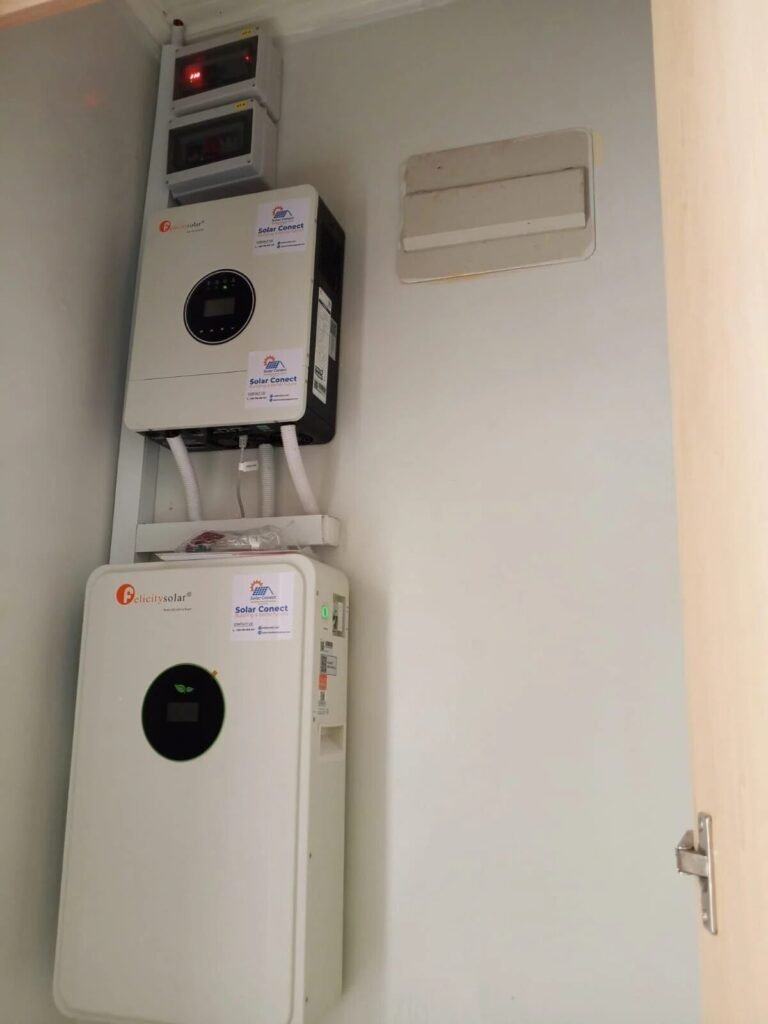
Popular 48V options in our shop include the Felicity 5kWh LPBF48100-M, the Hinen B5000 and the SRNE 10.24kWh SR-EOS10B for larger homes.
Upgrading from gel to lithium? We’ll check your inverter is compatible first.
FAQs
Can I replace gel batteries with a lithium battery on my current inverter?
Often yes, but the inverter must support lithium charging settings, and ideally communicate with the battery. Tell us your inverter model and we will confirm before you buy.
Can I mix old and new batteries, or gel and lithium?
No. Mixing chemistries, ages or capacities in one bank causes uneven charging and shortens battery life. Replace the whole bank, or add identical lithium modules designed to run in parallel.
How many years does a lithium solar battery last?
At roughly one cycle a day, a battery listed for 6,000 cycles is rated for over 15 years of cycling under test conditions. Real-world life is shorter in heat or with poor charging settings. Warranties on our lithium batteries are typically 3 to 5 years.
What is LiFePO4?
Lithium iron phosphate, the lithium chemistry used in most home solar batteries. It is valued for its long cycle life and thermal stability.