How to Size a Solar System for Your Home in Kenya (Step by Step)
Work out your daily energy use, then size the inverter, battery, panels and system voltage, with a worked example for a typical Kenyan family home and what it costs.
By the Solar Connect Kenya team · Updated

To size a home solar system in Kenya, add up how many watt-hours your appliances use in a day, then size four things from that number: the inverter (from the appliances that run at the same time), the battery (from the energy you need at night and during outages), the solar panels (daily energy ÷ sun hours, with a margin for losses) and the system voltage (12V, 24V or 48V). A typical family home using about 2.7 kWh a day is well served by a 3kVA 24V hybrid inverter, about 2.5–5 kWh of lithium battery and roughly 1.2 kW of panels.
Most solar problems we are called to fix in Nairobi and on the coast are sizing problems, not equipment problems: an inverter that trips when the fridge starts, a battery that is flat by midnight, or panels that never fully recharge the battery. Getting the numbers right before you buy avoids all three. Here is the same method our team uses, step by step.
Step 1: List your appliances and work out daily energy
Write down every appliance you want solar to power, its power in watts (on the label or in the manual) and how many hours a day it runs. Multiply watts by hours to get watt-hours (Wh), then add them up.
| Appliance | Power | Hours a day | Energy a day |
|---|---|---|---|
| 8 LED bulbs | 10W each | 5 | 400 Wh |
| TV and decoder | 100W | 5 | 500 Wh |
| Wi-Fi router | 15W | 24 | 360 Wh |
| Fridge | see energy label | cycles on and off | about 1,200 Wh |
| Phones and a laptop | 60W | 4 | 240 Wh |
| Total | about 2,700 Wh (2.7 kWh) |
These are example figures. A fridge’s compressor switches on and off, so use the yearly kWh on its energy label divided by 365 rather than its rated watts × 24.
Leave out heavy heating loads such as electric showers, kettles, irons and cookers unless you are planning a large system. They draw 1,500–3,000W each and are far cheaper to run on gas or a solar water heater.
Step 2: Size the inverter from what runs at the same time
The inverter has to supply every appliance that is switched on at once, plus the brief start-up surge of anything with a motor or compressor (fridges, freezers, pumps), which can draw several times its running power for a moment.
- Add up the watts of everything that could run together. In our example that is lights, TV, router, fridge and laptop: roughly 400–500W.
- Allow headroom for start-up surges and for appliances you will add later. Running an inverter close to its limit all the time shortens its life.
- For this home, a 3kVA inverter is a comfortable fit.
For most new installations we recommend a hybrid inverter, because it combines the inverter, solar charge controller and battery charger in one unit. If you mainly need backup and plan to add panels later, an inverter charger can also work. Our guide on hybrid inverters vs inverter chargers explains the difference.
Step 3: Size the battery from your night-time and backup needs
Batteries carry you through the evening, overnight and any power cuts. Work out the energy you use when the sun is down (in the example, about 1.5–1.6 kWh for lights, TV, router and the fridge overnight) and how long you want backup to last during an outage.
Then size by usable capacity, not the number on the label:
- Lithium (LiFePO4) batteries can be discharged deeply every day. Many in our range list 80–95% depth of discharge, so a 2.56 kWh battery gives you roughly 2 kWh of usable energy.
- Gel batteries should only be discharged to about half. The gel batteries in our shop list 1,500 cycles at 50% depth of discharge, so a 200Ah 12V gel battery (2.4 kWh) gives about 1.2 kWh of usable energy per cycle.
For our example home, a 2.56 kWh 24V lithium battery covers a normal night. A 5 kWh battery adds a comfortable buffer for long outages and future appliances. See lithium vs gel batteries for a full cost comparison.
Step 4: Size the solar panels from daily energy and sun hours
Most of Kenya receives roughly 4 to 6 kWh of solar energy per square metre per day, depending on location and season. For sizing, we treat that as about 5 peak sun hours and allow around 25% for real-world losses (heat, dust, wiring, battery charging).
Panel watts ≈ daily energy ÷ (sun hours × 0.75)
For the example: 2,700 Wh ÷ (5 × 0.75) ≈ 720W. We then round up so the panels can run the house during the day and recharge the battery, which gives about 1.2 kW. That is two modern panels such as the Jinko 580W monocrystalline panel.
Shade matters more than most people expect. A tree or water tank shading part of the array for a few hours can cut output noticeably, so we check the roof before finalising the design.
Step 5: Choose the system voltage
Battery-based systems run at 12V, 24V or 48V. Higher voltage means lower current for the same power, so thinner cables, less heat and better efficiency. As a rule of thumb:
| System size | Typical voltage | Suits |
|---|---|---|
| Up to about 1.5kVA | 12V | Lights, TV, phones, a small fridge |
| About 3kVA | 24V | A family home with a fridge and electronics |
| 5kVA and above | 48V | Larger homes, borehole pumps, offices and shops |
The inverter, battery and charge controller must all match the chosen voltage.
Worked example and what it costs
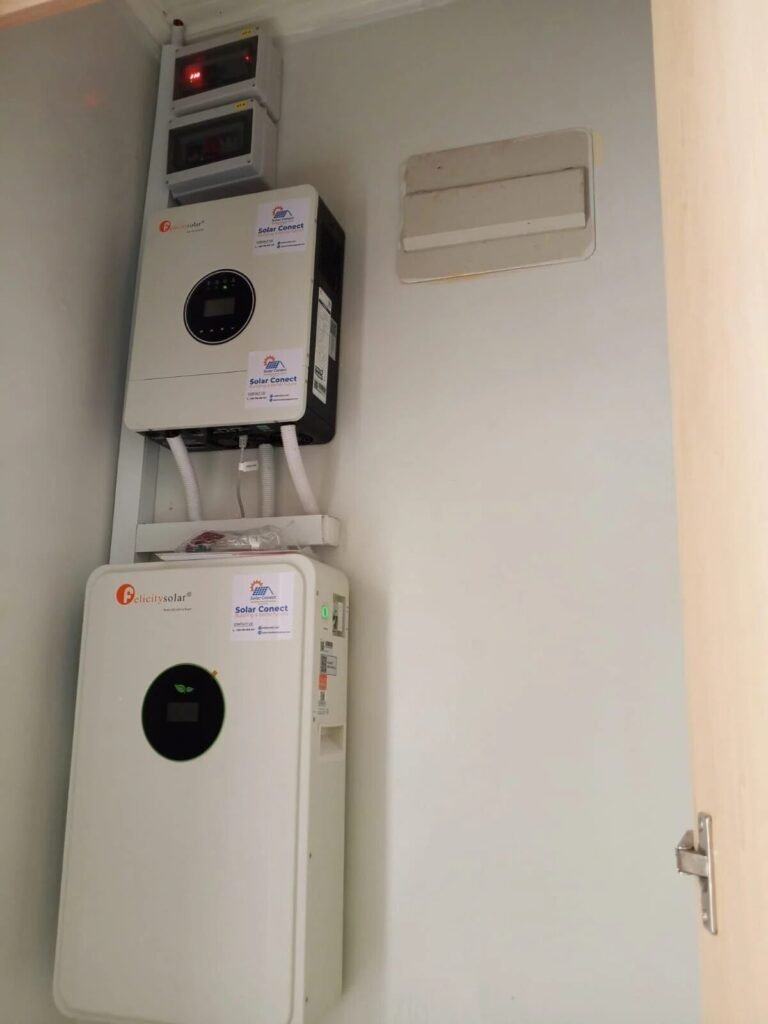
Putting the example together: about 2.7 kWh a day, a 3kVA 24V hybrid inverter, 2.5–5 kWh of 24V lithium battery and about 1.2 kW of panels, plus breakers, surge protection, cabling, mounting and earthing.
That is close to our 3kW 24V hybrid solar system package: 4 x 550W panels, a 3.3kW 24V hybrid inverter and a 5kWh Felicity lithium battery, with accessories, transport and installation included, listed at KSh 300,000. Our other complete solar packages range from a 1.5kVA 12V system at KSh 160,000 to a 10kW 48V system at KSh 565,000.
If you prefer to buy components, typical prices in our shop at the time of writing are a 3kVA 24V hybrid inverter from KSh 34,000, a 2.56 kWh 24V lithium battery at KSh 80,000 and 580W panels at KSh 10,440 each. Prices change, so check the product pages for current figures.
Common sizing mistakes
- Sizing the battery by its label. A 200Ah gel battery does not give you 200Ah of usable energy.
- Forgetting start-up surges. Fridges and pumps can trip an inverter that looks big enough on paper.
- Too few panels. The array has to power the day’s loads and refill the battery. Otherwise the battery slowly runs down day after day.
- Mixing voltages or brands without checking compatibility. Lithium batteries in particular need the right inverter settings or communication cable.
- Putting heating loads on solar. Electric showers and kettles are the fastest way to drain a battery.
Send us your appliance list and we’ll check the numbers for free.
FAQs
How many solar panels do I need for a 3kVA inverter?
It depends on your daily energy use, not just the inverter size. For a typical home using 2.5–3 kWh a day, about 1.2 kW of panels (two 580W panels) is a good starting point. Heavier daytime use or a bigger battery needs more panels.
How long will a 5 kWh lithium battery last during a blackout?
Divide usable energy by your load. At 80% depth of discharge a 5 kWh battery gives about 4 kWh. Running lights, TV, Wi-Fi and a fridge (roughly 300W on average) that is around 13 hours; with only lights and Wi-Fi it is much longer.
Can solar run a fridge and a borehole pump?
Yes, if the inverter can handle the start-up surge and the panels and battery cover the extra energy. Pumps are best run during the day straight from solar. They usually push a home towards a 5kVA 48V system.
Should I choose 24V or 48V?
Around 3kVA, 24V is common and cost-effective. From 5kVA upwards, or if you expect to expand, 48V is more efficient and gives you more inverter and battery options.